The Art of French Sauce Making: Béchamel and Beyond
The foundation of classical French cuisine rests on a small set of fundamental preparations known as the mother sauces. Among these, béchamel and velouté hold a central place, serving as the base for countless derivative sauces that appear in kitchens around the world. Understanding how these sauces are built, what their core components are, and how they can be transformed is a valuable skill for anyone interested in structured cooking. This article explores the methods behind béchamel and velouté, along with some of their most well-known variations, without promising perfection, but rather offering a clear view of the processes involved.
At EuroBites, we believe that a methodical approach to sauce making opens up a deeper appreciation for how ingredients interact. The techniques discussed here are rooted in tradition yet remain adaptable to modern kitchens. Whether you are a home cook or a professional, the principles of emulsion, thickening, and seasoning are universal. The goal is not to produce a single correct version, but to understand the range of possibilities that these sauces offer when prepared with attention and care.
The following sections outline the key techniques for béchamel and velouté, describe their classic derivatives, and provide contextual guidance on how these sauces fit into a broader culinary framework. Each step is presented as part of a process that can be adjusted according to the ingredients available and the desired outcome.
Understanding Béchamel: Roux and Dairy
Béchamel is one of the simplest mother sauces in terms of ingredients, yet it requires careful control of heat and timing. The sauce begins with a roux, which is a mixture of equal parts fat and flour cooked together. The roux can be white, blond, or brown depending on how long it is cooked, and for béchamel a white or blond roux is most common. The roux serves as a thickening agent that absorbs and binds the liquid, in this case milk, creating a smooth, creamy consistency.
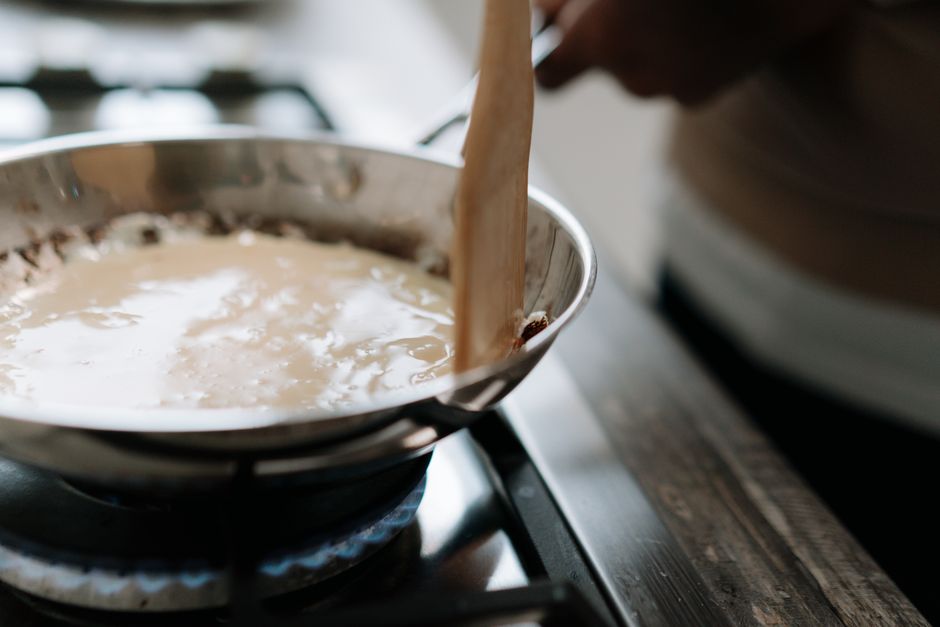
The process of making béchamel involves warming the milk separately before adding it to the roux. This helps prevent lumps and ensures even thickening. Once the milk is incorporated, the sauce is stirred continuously over medium heat until it reaches a gentle simmer. At this point, the starch granules in the flour swell and thicken the liquid. The sauce should be cooked for several minutes to eliminate any raw flour taste, but not so long that it reduces excessively. Seasoning typically includes salt, white pepper, and sometimes a touch of nutmeg, which complements the dairy flavor without overwhelming it.
One of the advantages of béchamel is its versatility. By adjusting the proportions of roux and milk, the cook can achieve different thicknesses, from a thin sauce suitable for soups to a thick sauce used as a binder. Béchamel also accepts flavor infusions easily. Adding bay leaves, onion studded with cloves, or a sprig of thyme during simmering imparts subtle aromatic notes. After straining, the sauce becomes a blank canvas for further variations.
Mastering Velouté: Stock and Roux
Velouté is another mother sauce that relies on a roux, but it uses a clear, unsalted stock as its liquid base. The stock can be made from chicken, veal, or fish, and the choice of stock determines the character of the final sauce. A chicken velouté will have a delicate, savory profile, while a fish velouté is lighter and more suited to seafood dishes. The roux for velouté is typically cooked until blond, as a darker roux would overpower the stock’s natural flavor.
The technique for velouté mirrors that of béchamel in many ways. The stock is heated and gradually whisked into the roux. The mixture is then brought to a simmer and stirred until it thickens. Because the stock already contains gelatin from bones, velouté often has a slightly silky texture even before additional enrichment. Cooking time can vary, but a simmer of 20 to 30 minutes allows the sauce to reduce slightly and concentrate its flavors. During this time, impurities may rise to the surface and can be skimmed off for a cleaner finish.
Velouté is notably more delicate than béchamel because the stock’s flavor is more pronounced. Seasoning must be adjusted accordingly, often with white pepper and a small amount of lemon juice to brighten the sauce. It is common to finish a velouté with a liaison of egg yolks and cream, which adds richness and body. This technique is particularly important for derivative sauces such as Sauce Allemande, where the velouté is thickened with egg yolks and finished with a touch of lemon juice and nutmeg.
Key Techniques for Consistent Results
Regardless of whether one is making béchamel or velouté, certain technical aspects contribute to a smooth, lump-free sauce. The first is the preparation of the roux. Butter is the traditional fat because of its flavor, but oil or margarine can be substituted. The flour should be stirred into the melted fat until it forms a paste and is cooked for the appropriate length of time. Adding liquid that is too cold to a hot roux can cause clumping, so warming the liquid beforehand is a common practice. Similarly, adding liquid too quickly can shock the roux; a slow, steady stream while whisking continuously is recommended.
Straining the finished sauce through a fine-mesh sieve is another step that improves texture. Even with careful whisking, small lumps or bits of cooked egg or seasonings may remain. Straining ensures a silky final product. Temperature control also matters. Sauces that are held at too high a heat for extended periods may break or develop a skin. Keeping the sauce covered with buttered paper or plastic wrap directly on the surface prevents a skin from forming while the sauce cools. These methods are not guarantees of success, but they create conditions that favor a stable emulsion and smooth consistency.
Another aspect is the use of aromatics. Both béchamel and velouté can be infused with herbs, spices, or vegetables during cooking. For example, a classic béchamel might include a slice of onion and a bay leaf, while a fish velouté could be infused with fennel and white wine. The aromatics should be removed after the sauce is strained, leaving only their subtle essence. This approach allows the cook to layer flavors without adding solids that might affect the final texture.
Classic Derivatives and Their Applications
From béchamel, several derivative sauces have become staples in French and international cooking. Mornay sauce is perhaps the most famous, adding grated Gruyère and Parmesan to béchamel, and is often used in gratins, croque monsieur, and macaroni and cheese. The cheese should be added off the heat to prevent it from becoming stringy. Another derivative is sauce Crème, which enriches béchamel with heavy cream and a touch of butter. Sauce Nantua, made with béchamel and crayfish butter, is a regional specialty that pairs with seafood.
Velouté derivatives are equally varied. Sauce Allemande, as mentioned, involves thickening a chicken velouté with egg yolks and cream. Sauce Poulette adds mushrooms and a liaison of egg yolks and lemon juice, and is often paired with poultry. Sauce Normande, based on fish velouté, incorporates mushrooms, egg yolks, and a splash of cider or apple brandy. These derivatives demonstrate how a single mother sauce can be transformed by small additions to suit different dishes. The key is to understand the base sauce’s characteristics and then adjust the seasoning and enrichment accordingly.
At EuroBites, we observe that the best results come from understanding the roles of each component. The roux provides structure, the liquid introduces flavor and body, and the finishing touches add complexity. The process is not rigid, and variations can be made based on dietary needs or ingredient availability. For instance, a plant-based version of béchamel can be made using a roux of olive oil and flour, with oat milk or almond milk as the liquid, and nutritional yeast for a cheesy note. Such adaptations may not taste identical to the traditional version, but they follow the same methodological principles.
Integrating Sauces into Dishes
The practical application of béchamel and velouté goes beyond serving them alongside a main course. These sauces are often used as components in layered dishes such as lasagna, casseroles, and gratins. A béchamel can be spread between layers of pasta and vegetables, providing moisture and binding the dish together. Velouté, on the other hand, works well as a base for soups, stews, or as a finishing sauce for poached fish or chicken. The thickness can be adjusted by adding more stock or cream, depending on the desired consistency.
One common technique is to use a béchamel as a binder for croquettes or soufflés. In these cases, the sauce is cooked to a very thick paste, then cooled before being combined with other ingredients. The starch in the sauce helps to hold the shape during frying or baking. Velouté can be reduced to a glaze-like consistency for coating meats, or it can be thinned to a soup-like consistency for a first course. The versatility of these sauces is limited only by the cook’s willingness to experiment within the framework of the basic method.
Because these sauces are built on fundamental techniques, they offer a reliable starting point for exploring broader culinary concepts. The skills developed while making béchamel and velouté—such as roux preparation, liquid incorporation, and seasoning balance—apply to many other preparations. The information presented here is intended to support understanding, not to prescribe a single path. Every kitchen and every cook will encounter variables that affect the outcome, and that is part of the learning process.